A Lexus can be a quiet, comfortable long-term vehicle, but a premium badge does not remove the need for careful safety research. Before buying or insuring a Lexus, look beyond the showroom presentation: identify open recalls, review crash-test information, inspect maintenance records, and price coverage for the exact vehicle identification number. The data is more useful than the marketing language.
I have spent years reading defect complaints and federal safety filings, and one principle remains consistent: a vehicle's reputation is not a substitute for checking the individual car. A well-maintained Lexus with completed recall repairs can be a sensible choice for a family. A neglected used example can create expensive and potentially dangerous problems, regardless of its model name.
Start with recalls and vehicle history
The first step is a VIN search through the National Highway Traffic Safety Administration's recall database. Do this before signing paperwork, not after bringing the vehicle home. A recall notice normally identifies the affected production population, the safety defect, the risk, and the remedy. It does not mean every vehicle with the same model name has the same issue. Production dates, equipment, and VIN ranges matter.
Ask the seller for proof that recall repairs were completed. Most recall remedies are performed without charge at an authorized dealer, although parts availability can delay the appointment. If a dealer says a repair is complete but cannot provide documentation, run the VIN yourself and request service records. An open recall should not automatically end a purchase, but it should affect timing, price, and your willingness to drive the vehicle before repair.
A vehicle history report can add useful context by showing reported collisions, title branding, odometer entries, and previous registration states. It is not a mechanical inspection. A used Lexus with a clean report can still have worn tires, damaged suspension components, water intrusion, or poorly repaired crash damage. Have an independent mechanic inspect the vehicle, especially if the seller resists a pre-purchase inspection.
What safety evidence can and cannot tell you
Crash ratings are valuable, but they require careful reading. The Insurance Institute for Highway Safety and NHTSA use different testing programs, so a strong result from one organization does not mean every possible crash outcome has been tested. Look at the specific model year and body style. A rating for a sedan should not be casually applied to a related SUV, and a redesigned vehicle can perform differently from the generation it replaces.
Modern Lexus vehicles commonly offer features such as automatic emergency braking, lane-departure warnings, adaptive cruise control, blind-spot monitoring, and rear cross-traffic alerts, depending on trim and model year. These systems assist the driver; they do not eliminate the need to watch traffic. Sensors can be affected by dirt, snow, damaged bumpers, poor weather, or windshield replacement. During a test drive, confirm that warning lights are absent and ask whether calibration was performed after collision repairs.
Pay attention to lighting, seating position, visibility, and the controls you will use every day. A parent transporting children may value easy access to rear seats and clear rear visibility more than a larger engine. An older driver may benefit from straightforward controls and a comfortable entry height. Safety is not just a laboratory score; it is also whether the driver can see, understand, and operate the vehicle without distraction.
Reliability depends on the exact vehicle
Lexus vehicles often benefit from Toyota-family engineering and a broad dealer and independent-repair network, but reliability is not identical across all models. The RX, ES, NX, IS, GX, and other vehicles use different platforms, powertrains, and equipment. Hybrid systems, turbocharged engines, air suspension, advanced driver-assistance hardware, and premium electronics can change repair costs substantially.
Request maintenance records covering oil or hybrid-system service, brake inspections, tire replacement, fluid changes, and software updates. For a used Lexus, a pre-purchase inspection costing roughly $150 to $300 can reveal tires that need $800 or more, brake work that approaches $600 to $1,200 per axle, or leaks that are far more expensive than a cosmetic flaw. Those ranges are planning figures, not guarantees, but they show why a low purchase price can be misleading.
A certified pre-owned program may include a limited warranty and inspection process, but read the actual coverage terms. Certification does not erase accident history or guarantee that every future repair will be inexpensive. Compare the inspection report with the vehicle history and ask specifically about tires, brakes, battery condition, and remaining warranty coverage.
Insurance costs deserve an early quote
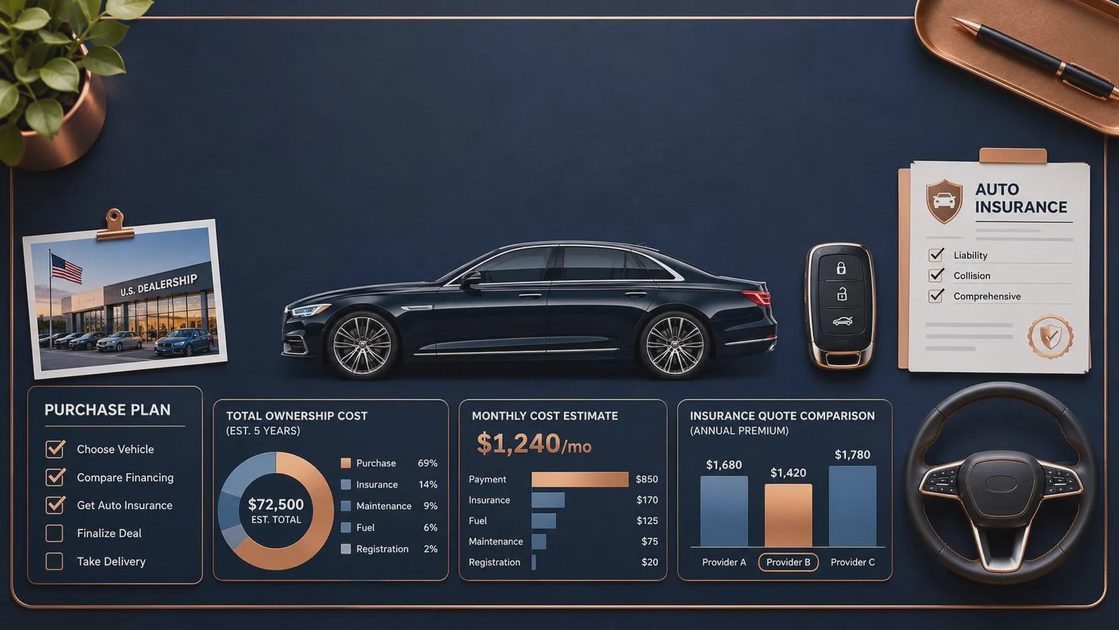
Insurance pricing for a Lexus is driven by more than the sticker price. Insurers consider the model, repair costs, theft trends, safety equipment, driver history, location, annual mileage, credit-based insurance factors where permitted, and selected coverage limits. A compact Lexus UX may produce a different quote from a high-performance IS or a larger GX, even when both are several years old.
For a financed vehicle, the lender generally requires comprehensive and collision coverage. Comprehensive helps address non-crash losses such as theft, hail, falling objects, and animal strikes. Collision addresses damage from a crash, subject to the chosen deductible. Liability coverage pays for damage or injuries you cause to others, while uninsured or underinsured motorist coverage can help when the responsible driver lacks enough insurance, subject to state rules and policy terms.
Get quotes before purchase using the exact year, trim, and VIN when available. Compare the same liability limits, deductibles, rental reimbursement, and roadside assistance across carriers. A quote that is $18 cheaper per month may provide meaningfully lower protection if the limits are reduced. Progressive, GEICO, State Farm, and regional insurers all price risk differently, so shopping several comparable policies can reveal a difference of hundreds of dollars per year.
A practical inspection plan for buyers
On a daylight visit, photograph the VIN, tire labels, warning lights, body gaps, glass markings, and underbody condition. Start the vehicle cold if possible. Listen for unusual rattles, observe exhaust behavior, and check whether the steering wheel sits straight on a level road. Test every seat belt, window, camera, sensor, and dashboard warning. Do not dismiss an airbag, brake, powertrain, or restraint-system warning as a minor electronic glitch.
During the road test, use city streets, a highway, and a parking area. Check braking, acceleration, transmission behavior, lane tracking, ride quality, and the operation of driver-assistance features. A seller who refuses a reasonable inspection is providing useful information about the transaction. Walk away rather than allowing urgency to replace evidence.
The same process applies when evaluating a Lexus already in your driveway. Look up recalls, maintain a record of completed repairs, and address warning lights promptly. If a collision has occurred, use a reputable repair facility and ask whether cameras, radar, steering, and restraint systems require calibration or diagnostic checks.
What owners should do this week
If you own a Lexus, this week's task is simple: locate the VIN, run the NHTSA recall search, and check your maintenance file. If an open recall appears, contact an authorized dealer and ask about parts, scheduling, and whether the vehicle should be driven before repair. If the vehicle has a safety warning light, arrange diagnosis rather than clearing the code without finding its cause.
Then request an insurance review. Confirm that liability limits reflect your assets and driving exposure, and examine whether comprehensive and collision deductibles still make sense as the vehicle ages. A higher deductible can reduce the premium, but it also means you need enough cash to handle a covered loss. Ask about multi-vehicle, safe-driver, low-mileage, defensive-driving, and bundling discounts without reducing necessary protection.
Here's what the data shows: a Lexus should be judged by its VIN, condition, crash evidence, maintenance history, and insurance quote—not by reputation alone. Here's what owners should do: verify the recall status, inspect the vehicle independently, understand its safety technology, and compare coverage before committing. That method protects both your household and your budget.


No notes on this sheet yet.