The new Acura NSX redesign has been a long time coming. Every sports car fan has an opinion, but here I want to slow down and look at what the evidence says. As someone who spent 15 years inside NHTSA, I read product plans differently. I look for the safety issues that only matter after the badge drops. The second-generation NSX left the market in 2022, and Acura has been quiet about its successor. That quiet is not a bad sign. It usually means the engineers are still working on the hard parts.
What We Know About the Next-Generation NSX
Acura has not confirmed a production date. What has emerged from concept previews and parent-company statements points toward an all-electric platform. Honda has committed to electrifying its lineup, and Acura previewed a Performance EV concept that many observers believe foreshadows the NSX replacement. A powertrain with three electric motors would be a natural evolution of the existing SH-AWD system that used a front motor pair and a rear engine-mounted motor to manage torque instantly. The old chassis was rigid, but it carried the weight of a battery pack, a 3.5-liter twin-turbo V6 and three electric motors. A battery-electric redesign can lower the center of gravity if the pack is placed low in the floor, but it also adds hundreds of pounds. The important question is not whether a future NSX will be quick. It will be. The question is how the extra mass affects braking, tire load, and crash energy.
Safety Lessons From the Hybrid NSX
Here's what the data shows from the previous NSX. The hybrid layout placed high-voltage cables close to the cabin, and the lithium-ion battery sat behind the passenger compartment. That design gave engineers a challenge: how to protect occupants and first responders during a collision. NHTSA and other agencies have published guidance on emergency response for electric and hybrid vehicles, and the NSX demanded a specific high-voltage disconnect procedure.
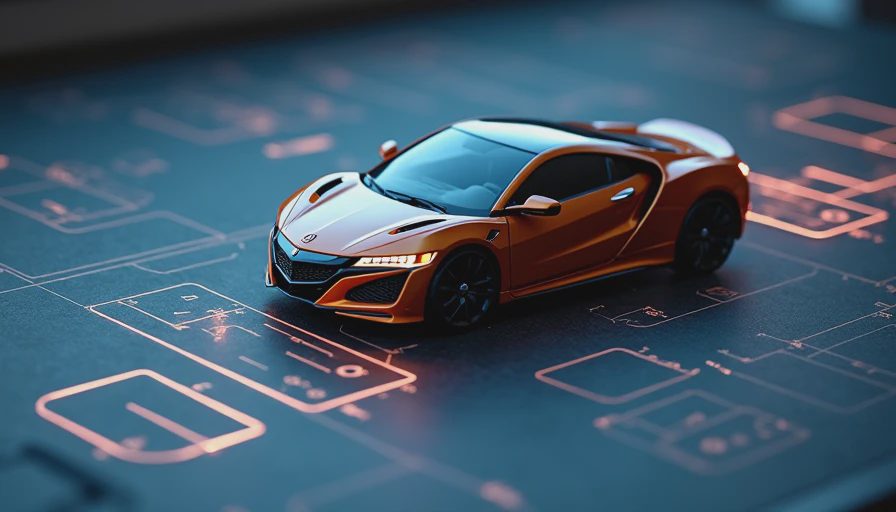
For the redesign, the battery pack will be larger, and it may be mounted under the floor. A floor-mounted pack has clear benefits for handling, but it sits closer to the crush zone in a side impact. Structural rails will need to route collision loads around the pack, and the battery enclosure has to survive without leaking coolant or causing a thermal event. That is not a reason to avoid an electric NSX. It is a reason to wait for crash-test results before assuming the badge is enough.
What the New Acura NSX Redesign Has to Match
Let's be honest about the current car. The 2017-2022 NSX was quick, mid-engined, and all-wheel-drive in a way that no other production Honda had ever been. But its sales numbers were modest, and its V6 soundtrack never thrilled purists. The new Acura NSX redesign cannot just repeat those choices. It needs a better interior, and it needs a nameplate strategy that gives buyers a reason to choose it over a Porsche 911 Turbo or a Tesla Roadster. The safety side is just as important. A high-output electric car with instant torque will push tires hard, so stability control and brake-by-wire systems need to be calibrated by engineers who understand drift and low-traction surfaces. I want to see a car that rewards drivers without tripping over its own electronics.
Price and Positioning: What Buyers Should Expect
Price matters because the old NSX started around $150,000 and climbed above $170,000 in its final years. That put it in direct competition with Audi, Porsche, and Ferrari. A new electric model could push past $180,000 before options, assuming Acura positions it as a flagship. That is a hard ask for a brand that most buyers associate with compact SUVs.

Acura needs to justify the money with tangible quality: solid build, durable battery, and crash protection that stands out. The used market is another factor. Second-generation NSX prices have softened, and some examples can be found in the $90,000 to $120,000 range. That makes the used car tempting. But an out-of-warranty hybrid supercar has expensive components. Battery cooling systems, electrical modules, and the twin-turbo V6 all carry repair costs that can exceed the price of a normal car waiting for replacement.
Crash Data and Low-Volume Reality: What Owners Should Do
Here is where I put on the investigator hat. Low-volume cars get less crash-test attention, and that does not mean they are weaker. It means there is less public data. For the new Acura NSX redesign, I want NHTSA to run a full-width frontal impact and a side impact with the updated pole test. I also want to see how the battery holds up in a rear-end collision, since a mid-mounted pack sits behind the driver. If you own a current NSX, your task this week is simple: confirm that all recall service has been completed, including anything related to the hybrid battery or high-voltage wiring. The NHTSA website has a searchable database, and the VIN lookup takes less than two minutes. For buyers waiting on the redesign, the task is to wait for the official crash ratings, not for the reveal video. The reveal will look good. The ratings will tell you the truth.
Wait or Buy Used
So should you buy a current NSX or wait for the next one? If you want the last of the hybrid V6 specials and you can handle the maintenance, a used car is a legitimate buy at the right price. If you want modern tech, a warranty, and a cleaner conscience, the new Acura NSX redesign is worth the wait. Just do not put money down on a reservation until you see the crash data. A thrilling car is not a safe car just because it has a famous name. Here's what the data shows and here's what owners should do: treat the reveal as marketing, treat the crash-test results as the engineering, and make your decision only after both are on the table.



No notes on this sheet yet.